Ulster
Ulster is a historic province in the north of Ireland comprising nine counties. Six counties (Antrim, Armagh, Down, Fermanagh, Londonderry, and Tyrone) form Northern Ireland, part of the UK. The remaining three (Cavan, Donegal, and Monaghan) are in the Republic of Ireland.
Details of the many historic and heritage sites in the six counties of Northern Ireland may be explored at: https://discovernorthernireland.com
Glenveagh
https://www.nationalparks.ie/glenveagh/
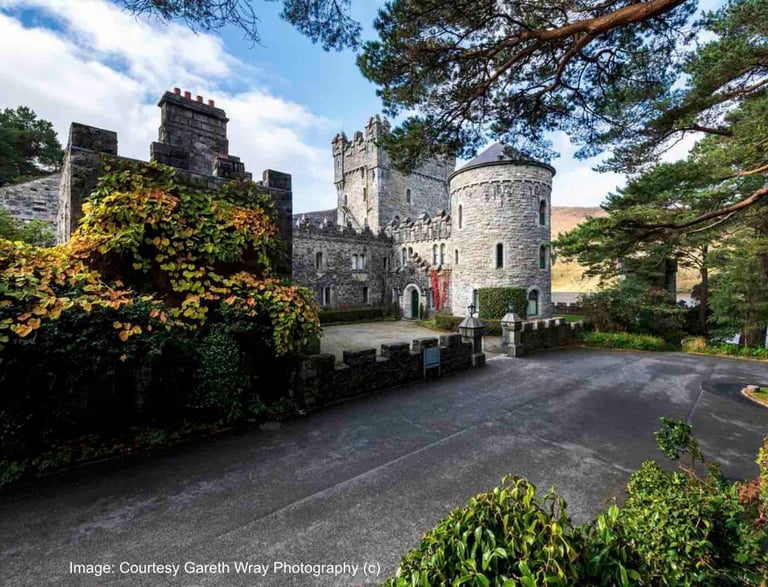
Glenveagh National Park lies in the heart of County Donegal, among the wild and rugged landscape of the Derryveagh Mountains. Its pristine habitats and protected wildlife, and its trails taking in the stunning Victorian Castle and Gardens along Lough Veagh, make Glenveagh the ideal escape for lovers of the natural world.
Set in a formerly wild mountain moorland, the castellated mansion was constructed starting in 1869 by John George Adair, whose wife Cornelia Adair maintained and enhanced the mansion and its gardens after his death. The last private owner, Henry McIlhenny of Philadelphia, sold the estate to the Office of Public Works in 1975 allowing for the creation of a National Park. In 1983 he bestowed the castle to the nation along with its gardens and much of the contents. Glenveagh National Park opened to the public in 1984 while the castle opened in 1986.
The Colmcille Heritage Centre
Gartan, Churchhill, Co. Donegal
T: 074 913 7021
https://www.discoveringireland.com/colmcille-heritage-centre/
St. Colmcille, born nearly a half century after St. Patrick, performed many feats of outstanding importance to the history of the Church. Born in the small village of Gartan in 521 AD, he was descended from royal blood, and by social standards, ranked as high as the king of Ireland. His nobility would prove an important tool later in his life for laying the foundations of his churches.
As a boy, Colmcille was sent to live with the priest who'd baptized him. Later, he moved to live and study with the Christian poet Gemman, and it was at this time that the young man's love of discipline, poetry, and knowledge came to life. King Diarmiad came into power a few years later. He was an enemy to Colmcille's father and thus to him. Soon, Colmcille's cousin offered him a site of a royal fort on the banks of the Foyle River, and in 546, the first Columban monastery (Doire Cholmkille, the oak grove of Colmcille) was founded.
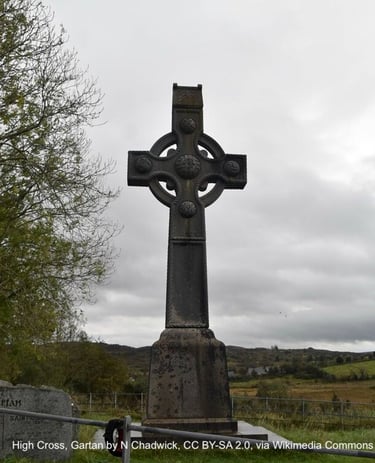
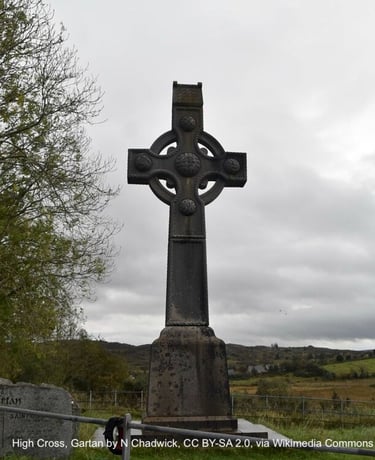
The Heritage Centre, overlooking Gartan Lake (three huge stones rising from it are called Colmcille's footsteps) depicts the life of early Celts, Patrick, and Colmcille through a series of illustrated graphic posters. Details of the history and life of Colmcille are highlighted in well written audio-visual presentation, and throughout the Centre are replicas of artefacts uncovered near sites where Colmcille lived and worked, the most striking a 12 feet high Celtic Cross that dominates the first-floor display room.
Colmcille, in his day, caused much controversy (and even a bloody war) because he copied, without permission, a Book of Psalms. Copying the illuminated manuscript entailed hours of tedious labour in the freezing temperatures with little light. These manuscripts proved especially difficult because of the richly colourful intricate designs. But Colmcille was so taken with the book that he laboured for well over a year in the most extreme conditions to make his own copy.
On display in the back room are several white oyster shells, each with a different coloured powder and each with a description of where and how colours for use in illuminated manuscripts were obtained.
Colmcille was eventually convicted of the first copyright infringement with this ruling: "To each cow its calf, to each book its owner." The ruling, in effect, exiled Columcille to Scotland where he lived, thrived, and created many monasteries.
The last display of the Centre is a wax-figure likeness of Colmcille as he might have looked. He has a Celtic tonsure (specific way of shaving head), wears a linen sheath, a woollen cloak, and leather shoes, all representative wear of the time.
Colmcille's story is told through a series of banners, stained glass panels, illustrations, and displayed artefacts. A visit will prove interesting, informative, and definitely worth the scenic drive around Gartan Lake.
The Colmcille Heritage Centre sits on the shore of Gartan Lough on the edge of Glenveagh National Park. Displays in the centre tell the story of Colmcille’s early years in the Gartan area and describe the spread of early Christianity in Ireland and Scotland, giving details of monastic and religious life.
There is a replica of the 6th-8th century Bell of St Columba which was kept in the Gartan area and passed down through successive generations of one family. It was said that water drunk from the bell would cure any illness.
The Centre is open from the first Sunday in May until the last Sunday in October. Mondays-Saturdays 10.30-17.00 and Sundays 13.30-17.00. (NOTE: MAY 2026 - temporarily closed)
Admission: €3 adults
Ulster Museum
The Ulster Museum, Stranmillis Road, Botanic Gardens, Belfast BT9 5AB
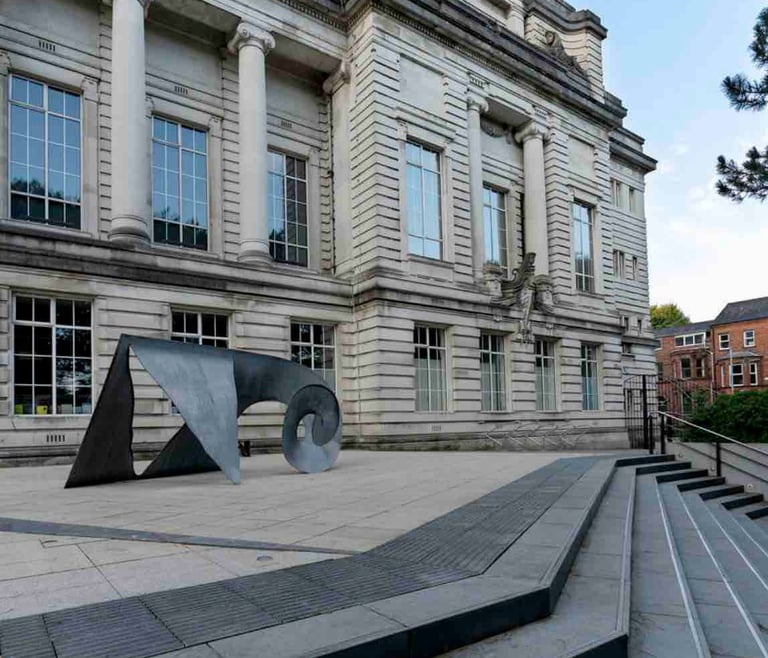
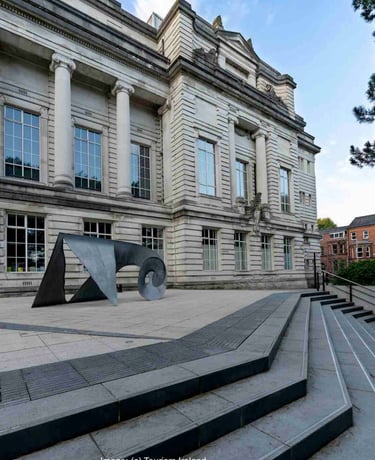
Set within the beautiful surroundings of Belfast’s Botanic Gardens, the Ulster Museum champions diverse voices and new perspectives to promote positive change in society. Within an architecturally innovative fusion of the classical and the brutalist, wide-ranging exhibits include fashion and costume, social and political history, palaeontology, archaeology and natural sciences.
Open: Tuesday to Sunday inclusive, 10.00-17.00, free admission
Ulster Folk Museum
Ulster Folk Museum, 153 Bangor Road, Cultra, Co. Down, BT18 0EU
Open: Tuesday to Sunday inclusive, 10.00-17.00
https://www.ulsterfolkmuseum.org
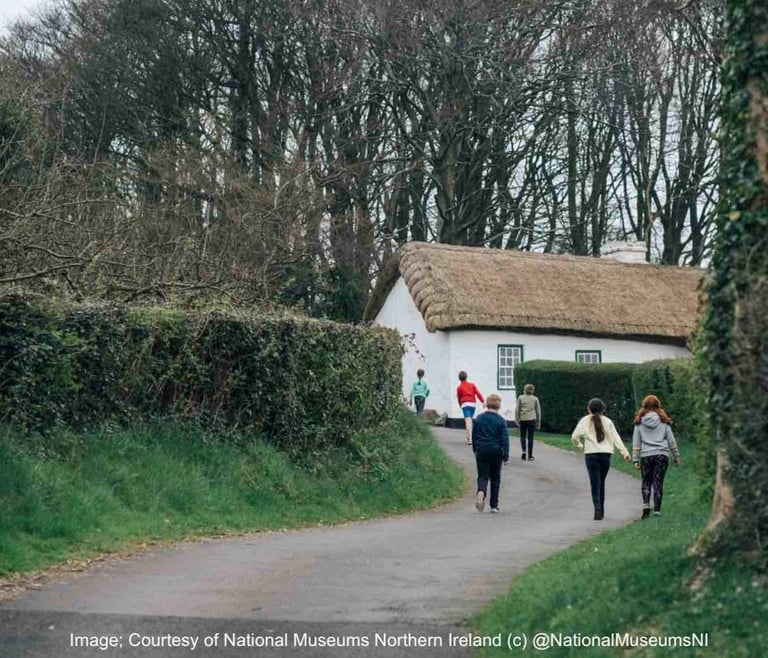
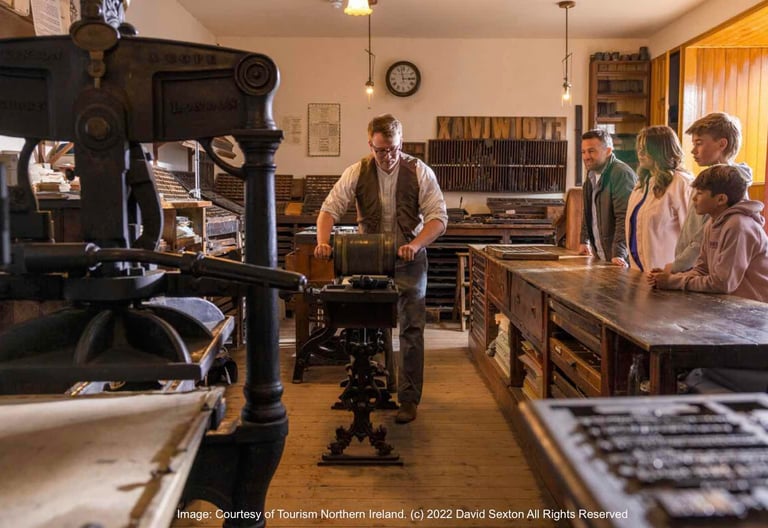
First opened in 1964, the Ulster Folk Museum is a remarkable living museum and environmental resource situated at Cultra, three miles east of Belfast. The exhibits are a collection of traditionally built and replica buildings. Some may close to the public for conservation, so please check the website for details. Talented demonstrators work daily, displaying traditional heritage skills. Each day there are always at least three demonstrations available from the list below.
Blacksmithing
Basket making
Linen weaving
Wool weaving
Printing
Carpentry
Needlework
Leather work
Food demonstrations
Traditional baking
First person interpretation
The Harland & Wolff Ship Plans Archive is now housed in the Cultra Collections Store, located at the Ulster Folk Museum.
Ulster Transport Museum
Ulster Transport Museum, 150 Bangor Road, Holywood BT18 0EY
https://www.ulstertransportmuseum.org
The Ulster Transport Museum tells the story of transport and social change in this part of the world since the birth of the midern era. It is a place to be inspired by big machines and big ideas.
You can access the North Down coastal path from the museum grounds. During your visit, take a walk outdoors and get to see more of the area. The gate is open during museum opening hours.
Open: Tuesday to Sunday inclusive, 10.00-17.00
Ulster American Folk Park
https://www.ulsteramericanfolkpark.org
Ulster American Folk Park 2 Mellon Rd, Omagh BT78 5QU
Open: Tuesday to Sunday inclusive, 10.00-17.00
028 8224 3292
The Ulster American Folk Park tells the story of Ulster people’s emigration to North America in the 18th and 19th centuries. Learn more about lives left behind, and the hardships endured on the journey. Wander the well-trodden pathways of rural Ulster, complete with a bustling street and welcoming farmhouses. Board the Brig Union ship and experience the cramped quarters where hundreds of people lived during their twelve-week Atlantic crossing. Emerge from the crossing and learn how our resourceful ancestors created new lives in a new land.
Titanic Belfast
Titanic Belfast, 1 Olympic Way, Queen's Road, Titanic Quarter, Belfast BT3 9EP
https://www.titanicbelfast.com
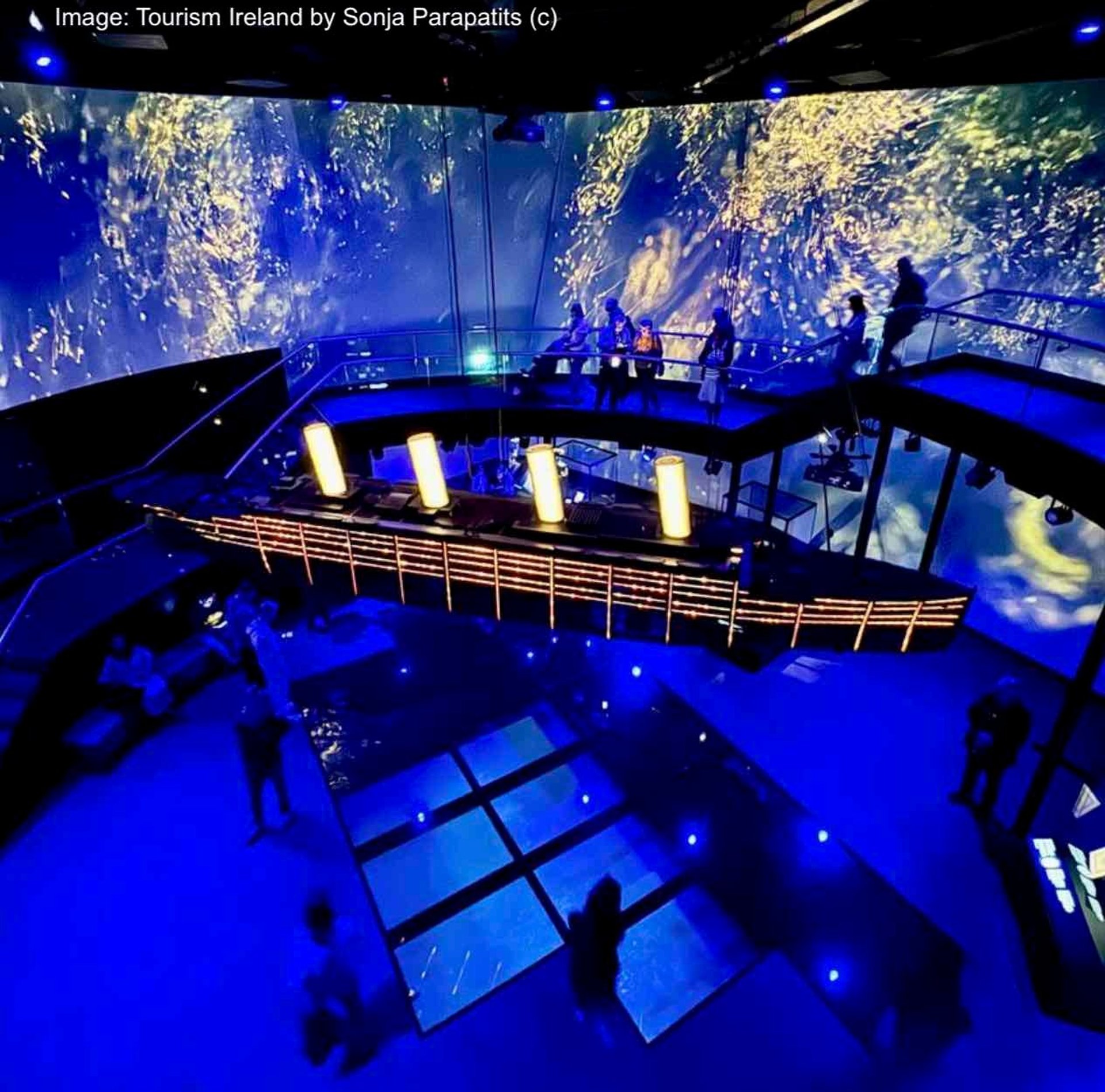
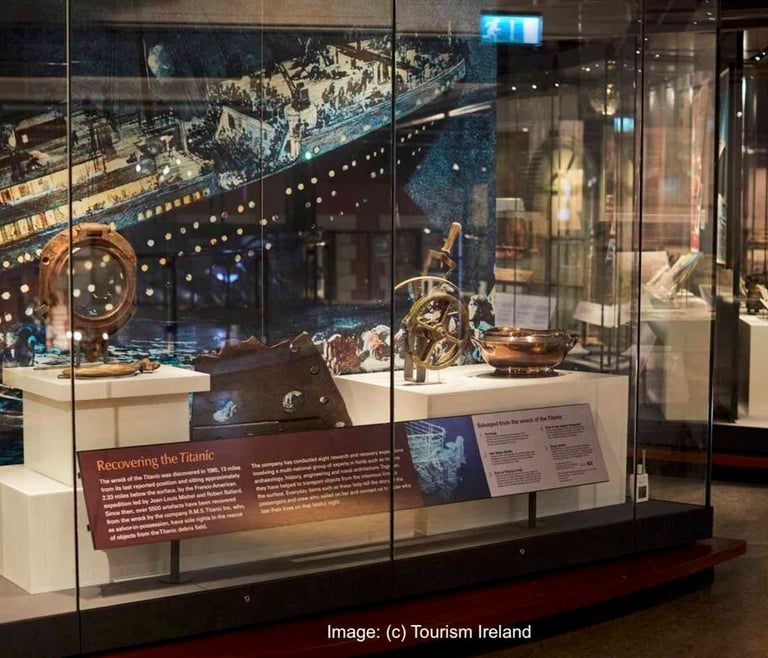
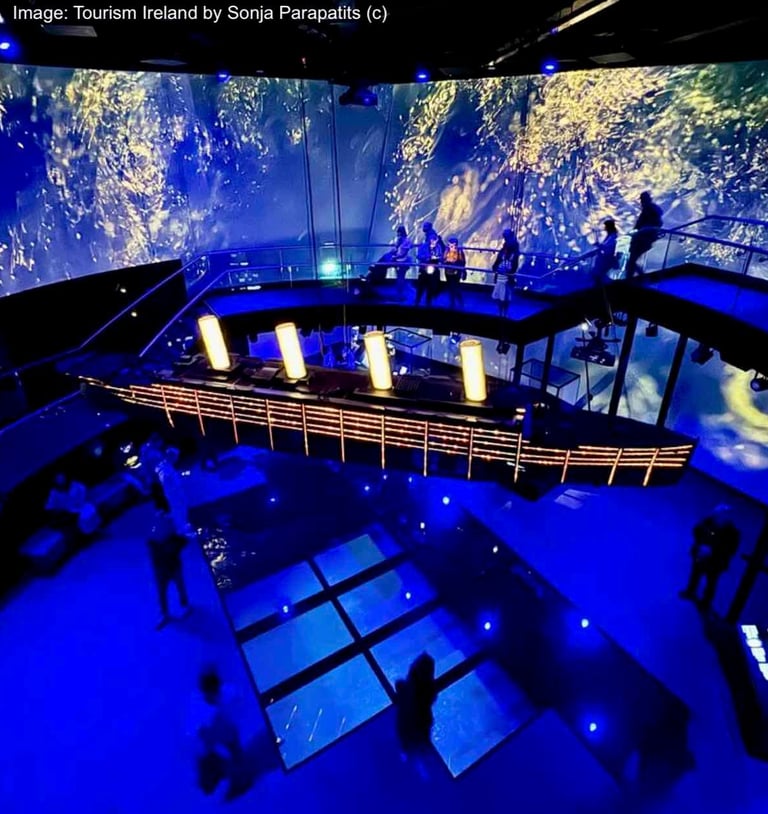
The iconic Titanic Belfast building and surrounding Maritime Mile is a leading visitor attraction. Located beside the Titanic Slipways, the Harland & Wolff Drawing Offices and Hamilton Graving Dock – the very place where Titanic was designed, built and launched, Titanic Belfast tells the story of Titanic from her conception, through her construction and launch, to her maiden voyage and subsequent place in history.
Opening hours vary through the year so check the website for dates and online booking. Adult admission from £20.
Florence Court
Florence Court, Enniskillen, County Fermanagh BT92 1DB, Northern Ireland
T: 02866348249
E: florencecourt@nationaltrust.org.uk
https://www.nationaltrust.org.uk/visit/northern-ireland/florence-court
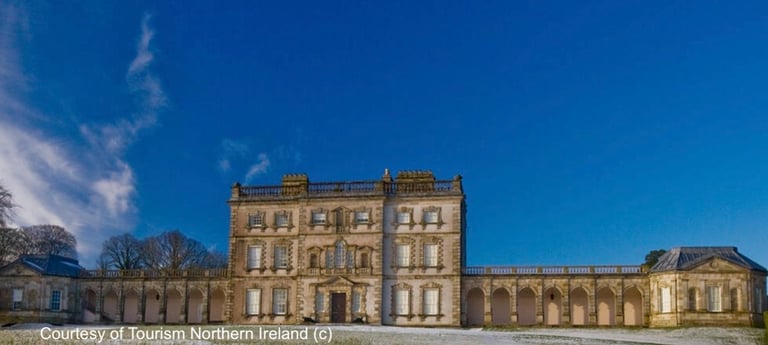
Beautiful 18th-century home set on a sustainable estate and gardens. Florence Court was the country residence of the Cole family for more than 250 years. It is a material symbol of the Coles’ inexorable rise from opportunistic military adventuring to the ranks of the aristocracy. Generation after generation, they helped to create the Protestant Ascendancy in Ireland. The architecture, artworks, books and furnishings of Florence Court combine with its glorious landscape setting to tell their story.
Prices:
Grounds only, adult from £10.50
Whole estate, adult from £16.50
Open each day in August 2026 from 10.00 to 17.00.
"When the legend becomes fact, print the legend..."
Subscribe for email updates:
© 2025, 2026. All rights reserved.
Web design: Maybelle Wallis
Special thanks to Ireland's Content Pool for permission to use images
Contact the HNS 2026 team:

Proudly sponsored by Fáilte Ireland, by the Irish Writers' Union, and by Larbok Creative:




Extend your stay - Discover Ireland!


Hosting Irish PEN: